
The NCERT's Class 9 Social Science textbook now includes the Special Intensive Revision (SIR) of electoral rolls, explaining its purpose to ensure accurate voter lists. The textbook also commends the Election Commission of India (ECI) for conducting impartial polls despite challenges, highlighting the scale and autonomy of India's electoral process.

The NCERT Class 8 social science textbook has undergone significant revisions, including a tweaked narrative on the 1947 Partition, the inclusion of VD Savarkar's demand for Swaraj, and the removal of references to Adolf Hitler and Nazi ideology. These changes follow a Supreme Court intervention regarding controversial content on the judiciary.
A number of academicians as well as political scientists Yogendra Yadav and Suhas Palshikar, who were part of the textbook development committee of the NCERT, had asked the council to drop their names from textbooks over 'several substantive revisions of the original texts'.
The new NCERT Class 9 mathematics textbook, 'Ganita Manjari', integrates ancient Indian mathematical systems and historical context, marking a shift from previous editions by emphasising indigenous contributions and linking concepts to ancient texts and scholars.

How did hundreds of errors slip through multiple stages of drafting, editing, proofreading, expert review and final approval before making their way into classrooms?
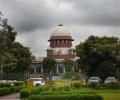
Three academics involved in drafting a controversial NCERT textbook chapter on corruption in the judiciary have approached the Supreme Court to defend their work, stating it was a collective effort and not the view of any single individual.

The suggestions have been part of the final position paper on social sciences, which is a key perspective document that helps in the development of new NCERT textbooks on the subject. The proposal has yet to get a final nod from NCERT.

"We teach our students using NCERT books...whatever is there in the revised edition will be followed," Deputy Chief Minister Brajesh Pathak said.
The UGC chief said the NCERT is fully justified in carrying out rationalisation of its textbooks' contents.

The 19-member National Syllabus and Teaching Learning Material Committee (NSTC) will be headed by National Institute of Educational Planning and Administration (NIEPA) chancellor MC Pant and develop textbooks for classes 3 to 12.

rediffGURU Nayagam PP, career counsellor and founder of EduJob360 explains why cracking the UPSC exam is a dream for lakhs of young Indians.
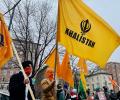
The NCERT has dropped references to the demand for a separate Sikh nation of Khalistan from the class 12 political science textbook following objections from the Shiromani Gurdwara Parbandhak Committee (SGPC), according to top education ministry officials.

The Election Commission's Special Intensive Revision (SIR) of electoral rolls has completed one year, leading to the deletion of nearly six crore voters across 19 states and Union territories. This exercise, which began in Bihar, has faced opposition criticism but was upheld by the Supreme Court. The purification drive has significant implications, including linking voter data to social security benefits in some states.

Palshikar and Yadav, who were chief advisors for the original Political Science books for classes 9 to 12, said, "While the modifications have been justified in the name of rationalisation, we fail to see any pedagogic rationale at work here. We find that the text has been mutilated beyond recognition. There are innumerable and irrational cuts and large deletions without any attempts to fill the gaps created.

He hinted that the same hue and cry is not made about 1984 riots not being in textbooks.
'You can see both being used in our textbooks already and that will continue in new textbooks'

Art education, physical education and wellbeing, vocational education and interdisciplinary studies will be compulsory.

The committee has also recommended highlighting 'Hindu victories' in various battles in the textbooks.

The SERT, an autonomous body of the general education department, is considering a decision by its curriculum steering committee to include these deleted portions in the state syllabus.

References to freedom fighter and India's first education minister Maulana Abul Kalam Azad have been removed from the new class 11 political science textbook by the National Council of Educational Research and Training (NCERT).

The signatories to a letter sent to NCERT Director Dinesh Saklani include Kanti Prasad Bajpai, a former Jawaharlal Nehru University professor who currently serves as the vice dean at the National University, Singapore, Pratap Bhanu Mehta, a former vice-chancellor of the Ashoka University, Rajeev Bhargava, a former director of CSDS, Niraja Gopal Jayal, a former JNU professor, Nivedita Menon, a JNU professor, Vipul Mudgal, the head of civil society watchdog Common Cause, K C Suri, a former professor at the University of Hyderabad who is now associated with the Gitam University, and Peter Ronald deSouza, a former director of the Indian Institute of Advanced Studies.
The National Council for Educational Research and Training (NCERT), however, said the withdrawal of anyone's association is out of question as textbooks at the school level are developed on the basis of knowledge and understanding on a given subject and at no stage, individual authorship is claimed.

The book, to be introduced in schools from the 2025-2026 academic year, marks a shift in tone in its portrayal of the Mughal emperors, offering detailed accounts of conquest, religious decisions, cultural contributions, and brutality.

Dropping references to the demolition of Babri Masjid in Ayodhya, the killing of Muslims in Gujarat riots and Hindutva, and tweaking the reference to Manipur's merger with India are among the latest set of revisions made public by the National Council of Educational Research and Training (NCERT) in its textbooks.

References to freedom fighter and India's first education minister Azad have been removed from the new class 11 political science textbook by the National Council of Educational Research and Training (NCERT).
Earlier this month, a controversy had erupted over the reduction of syllabus by the Central Board of Secondary Education due to the COVID-19 situation, with the Opposition alleging that chapters on India's democracy and plurality are being "dropped" to propagate a particular ideology.

As per the NCERT, the decision has been taken to reduce the content load on students in view of the COVID-19 pandemic.
'Whenever present-day politics do get involved, history sinks to the level of a morality play, with advocates for this or that cause seeking to praise their heroes or condemn their villains.'

Important chapters and topics you should prepare for.

Career counsellor Nayagam PP suggests 20 powerful steps you can take while balancing your board exams and other engineering entrance tests.
Noting that these three Cs haunt Indian education today, the Congress Parliamentary Party chairperson said in an article that this "carnage" of India's public education system must end.

The NTA had treated the two options as correct answers to the Physics question and had granted four marks to those examinees who had marked these options.
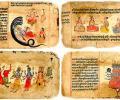
'Is there any harm in studying the history of India? This is not a regressive stand. The Vedas and Upanishads should be included in our textbooks,' says Dinanath Batra.
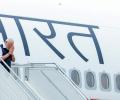
'Bharat is a name that is 7000 years old.' 'We are not saying the name of the country should be changed from India to Bharat; we only recommended that the stress should be on Bharat.'

There have been allegations of inflation of marks in NEET-UG which has led to a record 67 candidates sharing top rank with perfect score.

The agency is under criticism amid allegations of irregularities and inflation of marks in the crucial medical entrance exam.

The NTA denied any irregularities and said the changes made in the NCERT textbooks and grace marks for losing time at the examination centres were some of the reasons behind the students scoring higher marks.

The exam will be held on May 26 and 27, 2018.
